| Specification | Details |
| Prep Time (Shredding & Salting) | 30 minutes |
| Active Fermentation Time | 2 to 4 weeks (hands-off curing) |
| Canning Prep & Simmer Time | 25 minutes |
| Boiling-Water Bath Processing Time | 15 minutes (pints) / 20 minutes (quarts) |
| Total Time | ~3 weeks + 1 hour active kitchen work |
| Fermentation Intensity / Temp | Cool Room Temp (65°F–72°F / 18°C–22°C) |
| Canning Heat Intensity | High Rolling Boil (212°F / 100°C) |
| Skill Difficulty | Intermediate (Requires strict sanitation & headspace control) |
| Yield | 4 Pint Jars (16 oz each) or 2 Quart Jars (32 oz each) |
| Equipment Needed | 1-gallon glass fermentation crock or wide-mouth jar, fermentation weight, large mixing bowl, boiling-water bath canner with rack, 4 pint canning jars with new two-piece lids, jar lifter, bubble freer |
Understanding Fermentation & Canning Intensities
Successful canned sauerkraut depends on managing two completely different temperature environments:
-
Low-Intensity Microbial Fermentation (65°F to 72°F): During the first few weeks, keep your crock or jar out of direct sunlight in a cool pantry or kitchen corner. Temperatures above 75°F speed up fermentation too aggressively, resulting in mushy cabbage, while temperatures below 60°F slow the beneficial Lactobacillus bacteria to a crawl.
-
High-Intensity Water-Bath Heat Processing (212°F): Once the sauerkraut reaches your preferred tanginess, bringing the kraut and its brine to a simmer and processing sealed jars in a vigorous, rolling boil destroys spoilage yeasts and molds while driving air out of the jars to form an airtight seal. (Note: High heat kills live probiotics, so if you want raw probiotics, store the finished batch in the refrigerator instead of water-bath canning).
Ingredients
For the Fermented Sauerkraut Base
-
5 pounds (2.25 kg) fresh green cabbage (about 2 medium-large heads; choose tight, heavy heads with crisp leaves)
-
3 tablespoons (54 grams) pickling or canning salt (do not use iodized table salt, which clouds brine and inhibits fermentation, or salts with anti-caking agents)
-
1 teaspoon caraway seeds (optional, for traditional European flavor)
-
1 teaspoon whole juniper berries (optional, lightly crushed)
For Water-Bath Canning (If Brine Is Low)
-
½ cup distilled water (only if needed to top off jars)
-
¼ teaspoon pickling salt (dissolved in the extra water, if used)
Step-by-Step Instructions
-
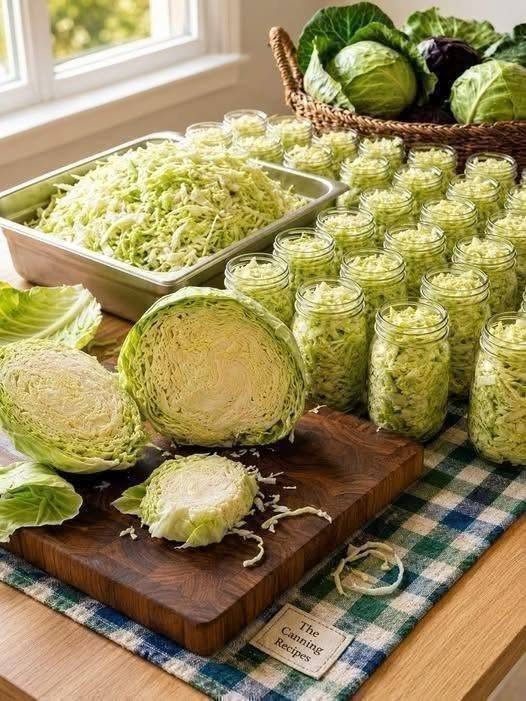
Prep and Shred the Cabbage (15 Minutes) Wash your hands, mixing bowls, knives, and fermentation vessel thoroughly with hot, soapy water and rinse well. Remove the tough, bruised outer leaves from the cabbage heads, setting aside two clean, intact outer leaves for later. Cut each head into quarters, slice out the dense white core, and shred the cabbage into thin, uniform ribbons about ⅛-inch thick using a sharp chef’s knife or mandoline slicer.
-
Salt and Massage to Create Brine (15 Minutes) Transfer the shredded cabbage into an extra-large stainless steel or glass mixing bowl. Sprinkle the 3 tablespoons of pickling salt evenly over the shreds, along with the caraway seeds and juniper berries if using. Using clean hands, vigorously massage, squeeze, and toss the cabbage for 8 to 10 minutes. The salt draws moisture out of the plant cells through osmosis; you are ready to pack when the cabbage looks translucent, limp, and sits in a generous pool of its own natural liquid.
-
Pack the Fermentation Vessel (5 Minutes) Pack the salted cabbage into a clean 1-gallon glass jar or ceramic crock a few handfuls at a time. Press down firmly after each addition using your fist or a wooden kraut pounder to eliminate trapped air pockets and force the liquid brine up above the shredded cabbage. Leave at least 2 to 3 inches of space at the top of the vessel so bubbling brine does not overflow.
-
Submerge Under Brine and Ferment (2 to 4 Weeks at 65°F–72°F) Fold the two reserved whole cabbage leaves and tuck them snugly over the top of the shredded kraut to keep tiny floaters trapped underneath. Place a clean glass fermentation weight (or a sealed zip-top bag filled with salted water) on top so all solids stay completely submerged beneath the liquid line. Cover the vessel with a breathable cloth secured by a rubber band, or fit it with an airlock lid. Place on a rimmed baking sheet in a cool, dark spot for 2 to 4 weeks. Taste a forkful starting at Day 14; once it reaches your desired sourness, it is ready to can.
-
Prepare Canner and Simmer the Sauerkraut (25 Minutes) Fill a large boiling-water bath canner halfway with water, place the rack inside, and bring to a simmer over medium-high heat. Wash 4 pint canning jars in hot, soapy water and keep them warm in the simmering canner until ready to fill. Transfer your fermented sauerkraut and all of its natural brine into a large stainless steel pot. Bring the mixture to a gentle simmer (185°F to 200°F) over medium heat, stirring occasionally for 5 minutes to heat the cabbage thoroughly. Do not boil it vigorously in the pot, or the shreds will soften.
-
Fill Jars and Adjust Headspace (10 Minutes) Use a jar lifter to remove the hot jars onto a folded kitchen towel. Using a wide-mouth canning funnel and slotted spoon, pack the hot sauerkraut tightly into the jars, ladling hot brine over top to cover the cabbage completely. Leave a strict ½-inch headspace from the rim of each jar. (If you run short on fermented brine, top off with boiling salted water made from ½ cup water and ¼ teaspoon pickling salt). Slide a non-metallic bubble freer or plastic spatula down the inside edges of each jar to release trapped air bubbles, re-check the ½-inch headspace, and wipe the jar rims spotless with a damp paper towel. Center the flat lids on the jars and screw the metal bands on until fingertip-tight.
-
Process in a Boiling-Water Bath (15 to 20 Minutes at 212°F) Lower the filled jars upright onto the rack inside the canner, ensuring the water covers the tops of the jars by at least 1 to 2 inches. Cover the canner with its lid and turn the heat to high until the water reaches a full, vigorous rolling boil. Once boiling hard, start your timer: process pint jars for 15 minutes or quart jars for 20 minutes (if canning at altitudes above 1,000 feet, add 5 minutes for every 1,000 to 3,000 feet of elevation).
-
Cool, Check Seals, and Store (12 to 24 Hours) When the timer finishes, turn off the heat, remove the canner lid, and let the jars sit undisturbed in the hot water for 5 minutes to prevent siphoning. Use a jar lifter to transfer the jars straight up onto a thick towel-lined countertop, leaving 1 to 2 inches of space between them. Let them cool completely for 12 to 24 hours without tightening the bands. Press the center of each lid—if it does not flex up and down, the vacuum seal is locked. Remove the metal rings, wipe the jars clean, label with the date, and store in a cool, dark pantry for up to 12 to 18 months. (Any jar that failed to seal should be refrigerated immediately and eaten within 2 weeks).
Complete Nutrition Information
Nutritional values are calculated per ½ cup serving (about 115 grams) of drained canned sauerkraut based on standard USDA ingredient data (16 servings per 5-pound batch).
| Nutrient | Amount Per Serving | % Daily Value* |
| Calories | 22 kcal | 1% |
| Total Fat | 0.2 g | 0% |
| — Saturated Fat | 0.0 g | 0% |
| — Trans Fat | 0.0 g | — |
| Cholesterol | 0 mg | 0% |
| Sodium | 640 mg | 28% |
| Total Carbohydrates | 4.9 g | 2% |
| — Dietary Fiber | 3.3 g | 12% |
| — Total Sugars | 2.0 g | — |
| Protein | 1.0 g | 2% |
| Vitamin C | 16.8 mg | 19% |
| Vitamin K | 15.0 mcg | 13% |
| Iron | 1.7 mg | 9% |
| Potassium | 195 mg | 4% |
